“I also kept the dirt on”
New exhibit focuses on local artists in dialogue with Earth
By Sherry Mazzocchi
Photos: NoMAA
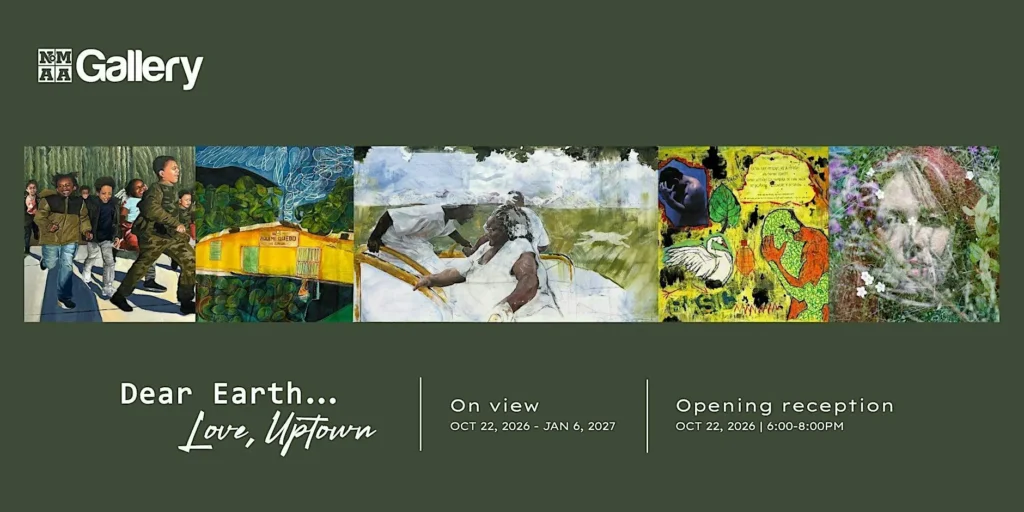
If you were to talk to the planet, what would you say?
In its latest show, Dear Earth…Love, Uptown, Northern Manhattan Arts Alliance (NoMAA) asks the question. It seems local artists have plenty to say about the state of nature.
“The show is a beautiful balance of questioning who we are and, ‘Have we been good?’” said NoMAA’s Executive Director Niria E. Leyva-Gutiérrez. “Most of the answers are ‘No, we have not.’”
Nature’s ephemeral beauty is highlighted in Emily Stedman’s watercolor, Field Flowers and Kae Sato’s Kiss of Cupid. Meanwhile, Franck de las Mercedes’ mixed media collage, Last Second of Life on Earth (A Destruction Myth), contemplates a Lenape legend where animals pass judgement on humans’ stewardship of creation.

Others have lighthearted takes. In a famous New Yorker cartoon, Felipe Galindo (Feggo) shows a mother polar bear disguising her cubs as pandas, hoping to evade loss of habitat due to climate change.
Mike Estabrook’s Billionaire Bug Demons depicts tech moguls as specimens, pinned for our inspection in a butterfly case. Estabrook previously depicted politicians as insects. Here, he includes the mega-rich in his taxonomic universe. The bugs, which he concocted by baking Shrinky Dinks in a toaster oven, represent the uber-wealthy he says have overtly taken over politics. Each bug’s carapace has a carefully drawn face. The identification tags have invented scientific names such as Oligarchus Dorkus, Luxuria Hotairus and Amazonea Parisitia. “With a lot of bugs, there is a scary face that you see at the bottom of the bug. It’s supposed to freak you out,” Estabrook said. “This scary face is a kind of monstrous reality, which is corporate capitalism where a psychopathic mind-set is the default rule of the whole system.”

Nature is a source of childhood joy in Christopher Gómez’s Running with Pencils. The painting was inspired by photos he took of his students on a scavenger hunt at Roberto Clemente State Park.
Gómez, who taught at the Bronx Children’s Museum, said, “They’re enjoying life. At that moment, in the sunset, in the wonder of it all. I wanted to capture that.”
Light is a key element in Chae Kihn’s two photos, Mushroom and Roots, which revel in the underside of mushrooms and the tangle of roots. “It’s not grandiose landscapes,” she said. “But you can see those landscapes if you look at small details of the vegetables or roots.”

She told The Manhattan Times that when people think of the Earth as “the other,” we feel separate from it. “We don’t see that we are actually part of [the Earth],” she said. Kihn usually photographs people, but here she lights vegetables as she would a person, emphasizing the intricacy and patterns of ridges and roots. “I try to take it out of its natural environment to create a sense of beauty,” she said. “But I also kept the dirt on.”
Houseplants also get their due. In a pixelated painting printed on board, Lance Foley’s Aglaonema was inspired by houseplants that he “innocently killed.” A laser cutter allowed him to incorporate negative spaces between the leaves. “I’ve never done painting that was dimensional like that,” he said. “I was curious if people would think it looked like a sign instead of a piece of art.” The pixelation reflects not only the piece’s ghostly inspiration, but also, he said, how people tend to blur things they don’t want to see.
Oscar M. Caballero’s S.C.A.R.E.C.R.O.W.S. is ingenious in both its technical execution and response to agricultural issues. Caballero, an architect who also teaches eco-fiction, inverted the concept of a scarecrow into a structure where birds actually facilitate land management.
S.C.A.R.E.C.R.O.W.S. starts in 2031, “after the collapse of humanity because of AI.” Where scarecrows and other technologies like motion sensors keep crows away from crops, this structure serves to attract them.
The bowl is designed to rock in the wind, with spouts to distribute seeds. Birds can pull the fibers to release the “three sisters” of corn, squash and beans. “[The seeds] basically have a symbiotic relationship of nutrients that they give to the soil, what they take from it, and how they create moisture for themselves. It’s a triad that allows them to grow successfully in a natural way before monoculture,” said Caballero.
His work went through several iterations, sketches and 3D printings. “It took a while,” he said. Using woven banana fibers for the strings and resin for the bowl, he combined ancient and modern equipment to complete his vision. “It’s sort of like this concept of ancestral-future technologies.”

In an agricultural painting, Narrowing Spaces Between Farmland and Residential, Janet Stewart explores the tensions between suburban sprawl and rural farms. Inspired by the Lancaster County countryside, where Amish and Mennonite farms have diminished in the face of growing population. “If we don’t take care of the land, we’re going to be demolished like the dinosaurs. It just won’t last,” she said.
Stewart favors deep greens, vibrant reds and natural umbers. “I like to use my hands in everything,” she said, pointing to her painting’s slightly turbulent blue and white sky. “I like to get messy doing my paintings.”
Elizabeth Starčević takes a cosmic approach in her weaving The Moon & Mars in the Water. As the two celestial bodies were close to each other in the sky, she imaged them as similar-sized orbs, just above the horizon, shimmering in the night and reflected in the Hudson River. “It’s our river, our world, and it’s something that we have to both treasure and take care of,” she said.

Leyva-Gutiérrez said the show was revelatory. “I’m blown away by what artists have submitted,” she said. More than 80 artists sent in over 200 images, making curation challenging. “It’s a wonderful problem to have.”
She added that about 30 percent of the show’s artists are new to NoMAA. “It reminds you of the amount of artists that live and work here—emerging, established, and everything in between. We’re very singular in that way. It just doesn’t exist anywhere else.”

Participating Artists:
Gloria Adams | Francisco Alvarado-Juárez | Valentina Bardavid Hoecker | Yael Ben-Zion | Stephen Beveridge | Peter Bulow | Oscar M. Caballero | Wendy Correa | Franck de las Mercedes | Rose Deler | Mike Estabrook | Lance Foley | Felipe Galindo (Feggo) | Christopher Gómez | Francis Hsueh | ioulex | Vandana Jain | Chae Kihn | Wildriana Paulino | Paula Maria Persiani | Kelly Pfister | Darcy Rogers | Kaé Sato | Tony Serio | Elizabeth Starčević | Emily Stedman | Janet Stewart | Joseph Taylor | Linda Vigdor
Dear Earth…Love, Uptown is on view until January 6, 2027 at NoMAA Gallery at 4140 Broadway (at 176 Street) First Floor, New York, NY 10033.Gallery hours are Saturdays 1-5 pm (excluding holidays) or by appointment. For more information, visit www.nomaanyc.org.